2011-03-21, 2010-12-25';
$update = '2011-12-07';
$description = "“Why is there no money left?“ - a search for causes and an attempt to find a solution.";
$keywords=", dept, financial crisis, economic crisis, crash, capitalism, “Miracle of Compound Interest”";
$titel = "“Why is there no money left?”";
$root = "../";
$css = "
table.xpw { float:right; }
table.xpw, div.xpw, img.wborder {border-width:1px;border-color:white;border-style:solid;margin:0.5em; }
table.xpw th { text-align:center; }
table.xpw td { text-align:right; }
div.left {float:left;max-width:30em;}
div.right {float:right;max-width:30em;}
blockquote {font-style:italic;margin-bottom:0.6em;}
img.rechtsBild, img.linksBild {border-color:white;}
div.h { width:10em;background-color:white; }
h2 { clear:left; }
div.rbox { float:right;max-width:25em;font-size:small;padding:0.5em; }
";
if (!function_exists('svg_embed')){
include $root . 'Include/svg_embed.inc';
}
/* Name der tatsächlichen Inhaltsdatei: */
$filename = __FILE__;
$ietext = 'Your web browser is too old! With
version 9 (2011?) even the
Internet Explorer can finally do what other browsers like
Firefox, Opera,or Safari can already do for years: display SVG.
Contents: Introduction - Basic problem 1: interest - Basic problem 2: origin of the money - Consequence: a constant redistribution from poor to rich - Solutions! - Links - Quotes
„We can only overcome
the fear from a future we
are afraid of with pictures
from a future we want.“
Wilhelm Ernſt Barkhoff,
Initiator of the GLS Bank
High moore landscape „Meeuwenven“, near Nijmegen (Nov. 2011)
Since I currently do not follow any English-language newspapers I must refer to the Wikipedia article about the financial crisis of 2007 to the present, which also includes a lot of information on the situation in the European Union and Greece. This whole page is not an exact translation of the German original, but uses different quotations and gives different (and less!) recommendations for further reading.
Introduction
How can there be “no more money left”? When I got my first pair of glasses, aged about 15, so it must have been 1995, the glasses where completely paid by (public) health insurance. A few years later the insurance first no longer paid the frames, then no longer gave any money at all. In 2005 the coalition of Social Democrats and Greens introduced tuition fees in my state (North-Rhine Westphalia). In 2009 my city’s household deficit reached a level where all “voluntary” expenses where forbidden by the district authorities - like for so many other cities and towns in the region. These are just three examples for the general tendency in Germany to steadily reduce the poorer people’s means of participation in society. In 2010 I finally found convincing answers to the paradox of steadily declining standards of living on the one side and ever increased productivity, record exports (“world champion” from 2003 to 2008), and decades without war (on German ground) and destruction on the other hand. Politicians and commentators like to blame “globalization” and the “demographic change” (which according to Google search results seems to be a term coined in Germany) for the deterioration, but neither of these explanations convince me. Instead I now hold our financial system responsible for it. The effects of this financial system where shown in the frequent newspaper headlines on financial crysis in 2010. In the beginning of 2011 this development continues: the US Secretary of the Treasury warns of an impeding government default on its dept - although the States are the only country in the world that can buy oil for self-printed paper. With the increasing age of our economies two basic defects of our financial system can less and less be compensated by taxes and social benefits:
Basic problem 1: Interest
Something must give when the mathematics of interest-bearing debt overwhelms the economy’s ability to pay. For awhile the growing debt burden may be met by selling off or forfeiting property to creditors, but an active public policy response is needed to save the economy’s land and natural resources, mines and public monopolies, physical capital and other productive assets from being lost to creditors.
From Michael Hudson’s Why the “Miracle of Compound Interest” leads to Financial Crises (2007)
| $100 “invested” (or owed) at different interest rates |
| |
1.00% |
2.00% |
3.00% |
5.00% |
7.00% |
10.00% |
| 10 years |
110.46 |
121.90 |
134.39 |
162.89 |
196.72 |
259.37 |
| 20 years |
122.02 |
148.59 |
180.61 |
265.33 |
386.97 |
672.75 |
| 30 years |
134.78 |
181.14 |
242.73 |
432.19 |
761.23 |
1744.94 |
| 40 years |
148.89 |
220.80 |
326.20 |
704.00 |
1497.45 |
4525.93 |
| 50 years |
164.46 |
269.16 |
438.39 |
1146.74 |
2945.70 |
11739.09 |
| 60 years |
181.67 |
328.10 |
589.16 |
1867.92 |
5794.64 |
30448.16 |
| 70 years |
200.68 |
399.96 |
791.78 |
3042.64 |
11398.94 |
78974.70 |
| 80 years |
221.67 |
487.54 |
1064.09 |
4956.14 |
22423.44 |
204840.02 |
| 90 years |
244.86 |
594.31 |
1430.05 |
8073.04 |
44110.30 |
531302.26 |
| 100 years |
270.48 |
724.46 |
1921.86 |
13150.13 |
86771.63 |
1378061.23 |
| doubling in: |
< 70 y |
< 36 y |
< 24 y |
< 15 y |
< 11 y |
< 8 y |
What happens when you lend out (“invest”) a certain sum of money at a certain interest rate? The amount of money grows, just as “on the other side“ the dept - and that happens exponentially! Here are some examples that I created with a spreadsheed application: what happens with $100, when you lend them (out) for a specific time at a certain interest rate?
'
.
svg_embed("exponential_growth.svg", "exponential_growth.png", "30em", "", "410", "328", "exponential functions", $ietext, '', "margin:0px;", "", 0)
.
'
As you see $100, “invested” at a (up until recently) modest interest rate of 5%, would become more than $13,000 after 100 years. Calculating with an “annual rate of return” of 10%, like some investors and CEOs do, these $100 would have become $1.4 million! The doubling time, which is given in my table’s last row, is less than 8 years at an interest rate of 10%. If you know about binary numbers, like any mathematician or programmer would, you know the powers of two by heart, i.e. you know what repeated doubling means: times 2, times 4, times 8, times 16, times 32, times 64, times 128, times 256, times 512, times 1024 (after doubling 10 times), ... the growth “explodes“ and soon excesses any imaginable dimension.
Basic problem 2: Origin of the money / being forced into dept
The system of banking we have both equally and ever reprobated. I contemplate it as a blot left in all our constitutions, which if not covered, will end in their destruction, which is already hit by the gamblers in corruption, and is sweeping away in its progress the fortunes and morals of our citizens. [...] And I sincerely believe, with you, that banking establishments are more dangerous than standing armies; and that the principle of spending money to be paid by posterity, under the name of funding, is but swindling futurity on a large scale.
Thomas Jefferson (1743-1826), Third President of the United States, in a letter on republican government to philosopher John Taylor.
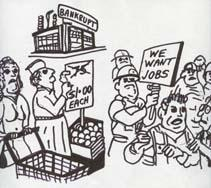
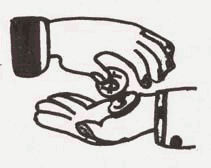
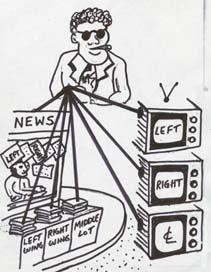 The story The Earth Plus 5% written by the Australian Larry Hannigan in 1971, strikingly explains why money at first was good for most people, but in the course of time made more and more of them fall into poverty. Thus our current money became the culprit for the worst of crimes, especially the constant wars. In short: since almost all money in the world come into existence as credit, there just is not enough money to pay back all loans. So there always have to be “losers” who cannot pay back their loans. While the number of “losers” increases over time, all the money concentrates in the hands of just a few. Incidentally it does not matter whether you see evil forces at work, as the story suggests, or if you consider it an unfortunate automatism of the money produced so far: the interest system’s repercussions described in the story and currently witnessed by us are real.
When you click the link to the story you also get to hear the text, if your computer supports sound. If English is not your preferred language there is an extensive list of translations available (albeit without the audio version): Bulgarian, Catalan, Czech, Dansk, English, Español, Francais, German, Italian, Japanese, Latvian Malay, Indonesian, Polski, Portugues, Russian, Serbo-Croatian, Turkish, Urdu.
The story The Earth Plus 5% written by the Australian Larry Hannigan in 1971, strikingly explains why money at first was good for most people, but in the course of time made more and more of them fall into poverty. Thus our current money became the culprit for the worst of crimes, especially the constant wars. In short: since almost all money in the world come into existence as credit, there just is not enough money to pay back all loans. So there always have to be “losers” who cannot pay back their loans. While the number of “losers” increases over time, all the money concentrates in the hands of just a few. Incidentally it does not matter whether you see evil forces at work, as the story suggests, or if you consider it an unfortunate automatism of the money produced so far: the interest system’s repercussions described in the story and currently witnessed by us are real.
When you click the link to the story you also get to hear the text, if your computer supports sound. If English is not your preferred language there is an extensive list of translations available (albeit without the audio version): Bulgarian, Catalan, Czech, Dansk, English, Español, Francais, German, Italian, Japanese, Latvian Malay, Indonesian, Polski, Portugues, Russian, Serbo-Croatian, Turkish, Urdu.
Consequence: a constant redistribution from poor to rich
'
.
svg_embed("redistribution.svg", "redistribution.png", "30em", "", "500", "315", "The redistribution visualised", $ietext, '', "margin:0px;", "", 0)
.
'
According to a combination of available data, estimates, and calculations more than 250 billion € are annually redistributed from the “poorer” 80% to the richest 20% of Germany´s population! The main argument in this calculation is: the interest the well-off receive has to be earned by someone and thus must be part of all the product prices. Today this interest component already amounts to an average of about 35% and when the assets (the capital) double (which is bound to happen at some point, as shown above) the interest component will have risen to more than 50% - of course only if no counter-measures are taken.
My Redistribution Calculator allows everyone to experiment with his or her own values for capital and interest!
Solutions!
Money requires the State, without a State money is not possible; indeed the foundation of the State may be said to date from the introduction of money.
Silvio Gesell in The Natural Economic Order (1920)
I chose this quote to show that the existing (i.e. produced by the European Central Bank, the Federal Reserve, or their respective counterparts) money needs not be accepted as “natural”. In fact it is just an agreement between men, which can be cancelled or modified.
'
.
svg_embed("freimarkt_en.svg", "freimarkt_en.png", "30em", "", "410", "258", "Inverted redistribution with Freigeld", $ietext, '', "margin:0px;", "", 0)
.
'
I pin a lot of hope on a new money like the “Freigeld” Silvio Gesell describes it his book The Natural Economic Order. The full text of the book seems to be available online in English, French, German, Spanish, and Italian.
If Germany had a working circulation safeguard (Freigeld), the redistribution of money from poor to rich, as displayed above, would no longer exist. Instead there would be a slight redistribution from those holding a lot of cash to those living on less money. With my Freigeld Calculator you can immediately start playing with different values for the circulation safeguard!

Based on Silvio Gesell’s ideas (“on the shoulders of giants”) I developed the concept of an online market place with its own neutral money: freimarkt.org
I hope to be able to make this operational as soon as possible - or for someone else to implement the concept!
Links
- Bob Marley - Rat Race “It’s a disgrace to see the human race in this rat race!”
- John Butler Trio - Revolution “All kicking and scrounging for the very first place / dictionary definition of a rat race”
- Beatles - Can’t Buy Me Love „I don’t care too much for money...“
- Michael Jackson - Money “You say you wouldn’t do it for all the money in the world? I don’t think so.”
- Tim Beam - The Ghost of my Money A video with nice pictures from the not too exciting movie „Der Geist des Geldes“ (The Spirit of Money).
- Money as Debt is a simple but thrilling documentary on the history and creation of our current money. It may not be totally accurate when describing how banks can create money, but it‘s probably closer to the truth than what you‘ve known about the process before (if anything at all). Alternatives to the current financial world order are discussed on the website and in the film, which is available for free download.
- Let’s make MONEY (IMDB entry) a calm, shocking, and great documentary with cineastic pictures.
- Life and Debt - A haunting documentary on what the policies of the IMF lead to.
- John S. Cooper - Zero the Dollar Crisis provides the setting for this 2010 thriller. According to internet sources the author is a German living in the States.
- Helmut Creutz - The Money Syndrome His book (that I read in the German original) is a very convincing and complete critique of money.
Quotes
“Prime minister Jose Zapatero justified austerity by saying his ‘hands are tied’ by the financial markets. This has encouraged a widespread view that there is no real democracy in Spain.”
SocialistWorker online, 24 May 2011
The ideas of and the motivations for the monetary reform proposed on this website are related to the ideas behind a basic income guarantee - so I conclude by “quoting” a pictogram the Pirate Party Berlin uses to advertise the basic income guarantee:
'
.
svg_embed("capitalism-communism-freimark.svg", "capitalism-communism-freimark.png", "100%", "", "406", "146", "Grundeinkommen-Piktogram der Berliner Piratenpartei", $ietext, '', "margin:0px;", "", 0)
.
'
';
include '../Include/layoutE.inc.php';
?>
